Learning to fly a drone is a practical and valuable skill these days.You will find that drone piloting requires dedication, technique and deep understanding of the equipment available on the market.
This complete guide on drone piloting course will transform your approach by mastering this technology.You will find advanced strategies and optimizations that most core courses do not address, allowing you to accelerate your development as a professional pilot.
Why choose a structured course to fly with drones
Many people try to learn on their own through random videos on the internet, but this generates waste of time and high risk of damaging expensive equipment. A course to fly with drones offers proven methodology, expert mentoring and logical progression that optimizes your learning. You save months of trial and error simply by following a path already validated by experienced professionals.
Recognized courses teach air regulations, flight safety, risk analysis, and emergency procedures that you need to master before operating a drone commercially.This solid foundation avoids hefty fines and problems with aeronautical authorities overseeing unauthorized operations.
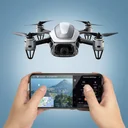
Go Fly Drone Camera Controller
Metaverse Labs
In addition, professional courses connect you with a community of pilots who share tips, job opportunities and advanced knowledge. This networking is worth gold when you want to turn your experience into income or improve your techniques through feedback from established professionals.
Essential structure of a good driving course
An excellent course for flying with drones starts with solid theory about aerodynamics, operation of brushless motors, batteries and remote control systems. You need to understand how each component influences the behavior of the drone in different weather conditions and altitudes. This theoretical basis eliminates uncertainties during piloting and allows you to diagnose technical problems quickly.
Practical progression should start in controlled environments, preferably in professional simulators before touching real drones. Modern simulators accurately reproduce the physics of real flight, allowing you to develop motor coordination and reflexes without risking equipment of thousands of dollars. After hours in simulator, the transition to real drones is natural and safe.
Subsequently, the course should offer progressive training with different drone models, from basic quadcopters to professional hexacopters with high-resolution cameras.You learn specific maneuvers, responsible acrobatic flight, aerial photography and terrain mapping. This diversity prepares you for any type of operation you may face in the professional market.
Regulations and legislation should also take up significant space in the curriculum.You study National Civil Aviation Agency requirements, flight notification procedures, no-fly zones and documentation required for commercial operations. Ignoring this part is risking your pilot license and your professional reputation.
Advanced strategies to optimize your riding learning
Most core courses teach the minimum required to fly safely, but advanced strategies go further. You should pursue first-person flight training (FPV), which requires completely different skills from traditional flight with aerial cameras. FPV pilots develop exceptional spatial perception and instantaneous reaction capability that significantly elevates their versatility as a professional.
Investing in positioning optimization and GPS navigation also differentiates you from mediocre pilots.You learn to calibrate inertial systems, set up waypoints with centimeter accuracy, and use real-time positioning data for mapping and inspection operations.
Aerial image post-production is another area where you can optimize a lot. In addition to capturing images, learn how to process videos, make drone foot editing, create 3D models from photogrammetry and geospatial data analysis. These complementary knowledge multiply your possibilities of generating income and added value for customers.
Mastering preventive maintenance and component repairs is also a crucial optimization strategy.You reduce operating and downtime costs by being able to diagnose and repair common problems yourself.This includes sensor cleaning, propeller replacement, camera recalibration, and structure repairs that would normally require shipping to authorized service.
Equipment needed to start your training
You do not need to start with the most expensive drone on the market, but you will need to invest in equipment that is suitable for your level. Beginner drones like DJI Mini offer good value for money, reduced weight for clearance of some records and enough durability to learn fundamental techniques without fear of damaging valuable assets. These models can perform almost 80% of ordinary professional operations.
Extra batteries are absolutely essential to optimize your practice time. Each battery offers approximately 20 to 30 minutes of flight, so multiple batteries mean more time in the air during your training sessions. A fast charger that charges four batteries simultaneously saves valuable time between flights.
Investing in ND filters, polarizers and other optical accessories significantly improves the quality of the images you capture while learning. These lenses work like sunglasses for the drone camera, reducing reflections and improving contrast on sunny days.
A smart charging station with stabilized voltage protects its batteries and extends its service life significantly. Improvised chargers generate excessive heat and rapid degradation of cells. A good professional charger invests its durability, automatically balances the cells and monitors temperature throughout the charging process.
Building your professional career after the course
After completing your drone piloting course, you face an important decision: to work as a freelancer or integrate with a specialized company. Freelancers gain flexibility and higher income potential, but deal with project instability and the need for self-management.
Market segmentation is critical to financial success.You can focus on aerial photography for real estate, mapping for agriculture, structure inspections, filming for producers or photogrammetry for engineering projects.Each segment has different characteristics, customers and prices.You thrive by specializing in a niche that combines your skills with real demand from the local market.
Professional portfolio is your most important business card.You must document each project carried out, showing quality of images, creativity in composition and practical results delivered to the client. Platforms such as online portfolios, professional social networks and YouTube act as showcases that attract new customers constantly.
Professional certification adds massive credibility to your curriculum.You seek ANAC-recognized certifications, specialized courses in photogrammetry or infrastructure inspection, and training in specific software used by government agencies and large companies.
Common challenges during learning and how to overcome them
Many students face initial difficulty with motor coordination, especially when controlling two joysticks simultaneously independently.The right side controls height and rotation while the left controls horizontal movement in different directions.You overcome this by practicing in simulator before flying for real, developing muscle memory without pressure to damage real equipment.
Loss of visual orientation during flights is another frequent challenge, especially in environments with confusing structures such as forests or dense urban areas. You solve this by practicing in open and familiar places first, establishing clear visual landmarks and relying on the altitude and distance data shown on the remote control.
Improper battery management causes dangerous emergency landings that damage the drone.You learn to constantly monitor the available load, plan routes that allow safe return and never fly with battery below 20% payload. Using alarms on the remote control that warn in real time about critical battery levels is essential practice.
Strong wind is enemy of novice pilots because it makes the drone unstable and difficult to control manually. You respect weather limitations, checking wind forecast before each session and avoiding flights when the gusts exceed the capacity of your equipment. In time, you learn to compensate for gusts of wind through micro-adjustments in the commands, but at first, expect better conditions is intelligence.
Freezing or locking of camera images impairs important flight documentation. You avoid this problem by making sure that memory card has sufficient speed, updating drone firmware regularly and testing recording before starting critical operations. A failed card at the wrong time can ruin an important customer, so priority is to use reliable equipment.
Future trends in drone piloting and continuous preparation
Artificial intelligence is transforming drone piloting through automatic object detection, autonomous tracking of people and predictive analysis of collected data. You must keep up to date on these technologies by regularly studying technical articles, participating in specialized webinars and experimenting with new software that integrates AI into your workflows. Professionals who master these tools gain huge competitive advantage.
Fully planned autonomous flights without real-time human intervention gain increasing space in commercial operations.You learn to plan complex missions using mission planning software, setting up automatic drone behaviors and setting safety limits that work without pilot tapping on controls. This automation increases operational efficiency and reduces human fatigue in long projects.
Regulation also evolves rapidly with increased safety requirements and new registrations for operators.You keep your certification up-to-date, study regulatory changes announced by aeronautical authorities, and adjust your operating procedures to remain legally compliant. Ignoring regulatory updates puts your business at constant risk of fines and suspension of activities.
Cyber security in drones is a growing concern as hackers develop methods to interfere with communications and hijack control remotely.You protect your operations by using private networks when possible, updating firmware regularly, and investing in equipment with robust security protocols.